
游戏化非货币激励对员工绩效与参与度的影响
本文是一篇 人力资源管理论文,本研究以三大理论为基础:自我决定理论(SDT)强调自主性、胜任感与归属感是激发内在动机的核心要素;JD-R 模型指出工作资源可缓冲压力、增强参与度;觅食理论则提供了一个动态行为分析视角,将员工在“留下”与“切换”任务之间的权衡视作成本-收益决策过程。该理论首次被引入组织行为研究。
Chapter 1 Introduction
1.1 Research Background and Research Question
In today’s rapidly evolving world, organizations are constantly seeking ways to enhance their competitiveness and performance. As businesses expand across various industries and markets, the need to understand the factors driving employee motivation and engagement has become more critical than ever. Companies are increasingly recognizing the importance of non-monetary Incentives, such as recognition, personal development opportunities, and a positive work environment, as essential components for improving employee performance and satisfaction. One of the most innovative approaches to enhancing employee engagement is gamification. The integration of game elements into non-game contexts has been shown to increase motivation, foster a sense of achievement, and drive higher performance levels among employees. However, despite the growing interest in gamified strategies, research remains divided on their effectiveness, with some studies highlighting the positive impact of gamification, while others caution about its potential drawbacks, such as the risk of burnout or decreased intrinsic motivation. This research aims to explore the impact of gamified non-monetary rewards on employee engagement, focusing on three key dependent variables: Job engagement, and job performance. Foraging behavior refers to the process by which employees decide whether to remain in their current roles or explore new job opportunities. Job satisfaction pertains to the emotional and cognitive response of employees to their work environment, which directly influences their engagement and motivation levels. Job performance represents the efficiency and effectiveness with which employees carry out their job tasks.
人力资源管理论文怎么写
.......................
1.2 Research Objectives and Significance
1.2.1 Research Objectives
The objectives of this study are as follows:
1-To analyze the impact of gamified non-monetary Incentives on employee job satisfaction.
2-To analyze how gamified non-monetary Incentives influence employee foraging behavior in job selection and retention decisions.
3-To analyze the effect of gamified non-monetary Incentives on Employee performance.
4-To analyze whether gamified non-monetary Incentives lead to higher levels of employee engagement compared to monetary Incentives.
5-To examine whether the implementation of gamified non-monetary Incentives influence foraging behavior, such as the time spent in each job situation (patch) and decisions to leave or stay in those situations.
6-To investigate whether employee engagement mediates the relationship between gamified non-monetary incentives and employee performance.
7-To Develop a comprehensive and multidisciplinary approach for investigating motivation and satisfaction in the fields of business and Human Resource Management studies.
.....................
Chapter 2 Hypothesis and Theoretical Framework
2.1 Theoretical Foundation
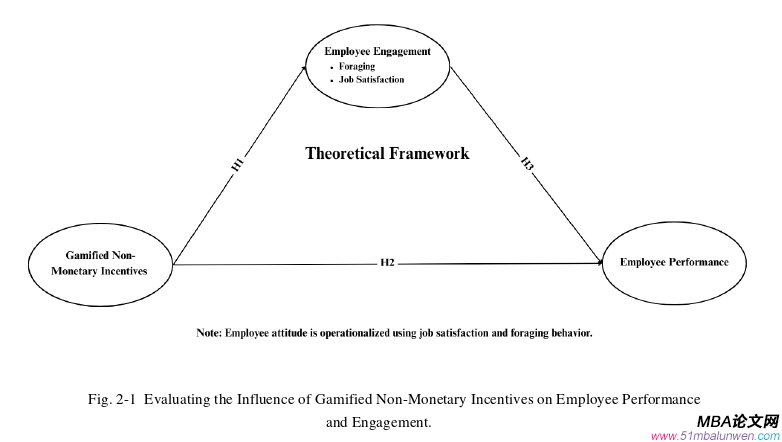
In today’s competitive work environment, organizations seek innovative strategies to enhance employee motivation and performance. Traditional monetary incentives are no longer the sole drivers of workplace engagement, and firms increasingly turn to alternative approaches such as gamified non-monetary incentives to sustain employee satisfaction and productivity. Businesses need to understand how these strategies impact employee behavior and engagement to remain competitive in dynamic labor markets (Deci et al., 2001)[60].Organizations that effectively implement gamified non-monetary reward systems create environments where employees feel motivated to perform, leading to improved workplace outcomes. Prior research highlights the significance of intrinsic and extrinsic motivation in employee engagement (Howard et al., 2021)[15]. Gamification techniques such as leaderboards, badges, and achievement systems reinforce engagement by fostering competition and progression within the workplace. Likewise, structured non-monetary incentives such as recognition and development opportunities can enhance motivation without direct financial compensation (Gubler et al., 2018)[63].However, the effectiveness of gamified non-monetary incentives depends on employees’ perception of their value. Research suggests that when employees feel their contributions are acknowledged through these incentive structures, their levels of job engagement and performance improve significantly (Rahiman et al., 2023)[11]. On the other hand, organizations that fail to align their reward systems with employees’ intrinsic needs may see diminishing returns from such strategies. Additionally, foraging behavior, derived from behavioral decision-making theories, provides a novel lens to understand employee engagement. Employees constantly evaluate workplace incentives, deciding whether to persist in a task or explore new opportunities (Sugie, 2018)[22].
.....................
2.2 Hypothesis Development
2.2.1 Gamified Non-Monetary Incentives and Job Engagement
In modern workplace environments, employee engagement has become a key determinant of organizational success, influencing not only individual performance but also long-term retention and workplace satisfaction. One increasingly popular method for enhancing engagement is the implementation of gamified non-monetary incentives, which combine symbolic recognition and personal development incentives with motivational features drawn from game design, such as points, badges, leaderboards, progress tracking, and real-time feedback mechanisms (Hamari et al., 2014)[69].Unlike traditional monetary incentives, which may lead to short-term performance improvements but often fail to sustain long-term motivation, gamified non-monetary rewards are specifically designed to foster intrinsic motivation, encouraging employees to remain emotionally and cognitively invested in their tasks over time (Cerasoli et al., 2014)[61]. These systems draw heavily from Self-Determination Theory (SDT), which posits that individuals are more motivated and engaged when their psychological needs for autonomy, competence, and relatedness are fulfilled (Deci et al., 2001)[60]. Experimental studies have confirmed these mechanisms. In a simulation-based workplace task, (Sailer et al., 2017)[70]found that elements like performance graphs and badges significantly increased perceived task competence and task meaningfulness, resulting in higher engagement. Further, (Bernecker & Ninaus, 2021)[71]demonstrated that gamification reduces motivational conflict and subjective effort in demanding tasks.
.........................
CHAPTER 3 RESEARCH METHODOLOGY ....................... 24
3.1 Research Design ............................................ 24
3.1.1 Environment Design ....................................... 25
3.1.2 Independent Variables ......................... 26
CHAPTER 4 DISCUSSION AND SUGGESTION ....................................... 55
4.1 Discussion .......................................... 55
4.2 Novelty................................................ 57
4.3 Limitations ..................................... 57
CONCLUSION .............................. 62
Chapter 4 Discussion and Suggestion
4.1 Discussion
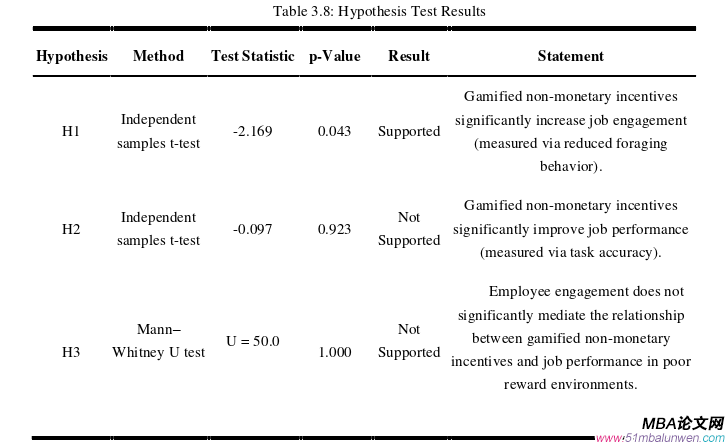
This study examined the impact of gamified non-monetary incentives on two key workplace outcomes employee engagement and performance within a simulated task environment. The results revealed that while gamified non-monetary incentives significantly reduced foraging behavior, indicating higher symbolic engagement and task persistence, they did not yield improvements in short-term task accuracy. These findings offer both theoretical and practical insights that expand current understandings in organizational psychology and human resource management. The observed reduction in foraging behavior among participants in the gamified condition suggests enhanced persistence even in less rewarding environments. This supports Self-Determination Theory (Ryan & Deci, 2000) [14], which argues that intrinsic motivation increases when individuals feel autonomous, competent, and connected. In this study, elements such as symbolic feedback (rank badges), real-time progress (stamina bar), and social comparison (scoreboard) likely contributed to fulfilling these needs, thereby encouraging sustained effort. This aligns with findings from Gillet et al. (2018) [2] and Olafsen et al. (2015) [19], who also emphasize the role of non-monetary incentives in fostering intrinsic engagement.
人力资源管理论文参考
.............................
Conclusion
In today's fiercely competitive global landscape, the quest for effective employee motivation and engagement strategies remains a paramount concern for organizations striving for sustained success. While traditional financial incentives play a role, their inherent limitations budgetary constraints, diminishing returns, and an often-inadequate address of deeper psychological needs necessitate exploration into more holistic approaches. This dissertation was driven by the critical need to investigate emerging strategies, specifically focusing on the impact of gamified non-monetary incentives compared to conventional monetary rewards. The core significance of this research lies in its systematic, empirical examination of how these distinct incentive structures influence employee engagement (viewed through behavioral persistence and satisfaction) and work performance within a controlled, simulated environment. By integrating established motivational theories with the novel application of Foraging Theory, this study aimed to offer both theoretically advanced insights and practically valuable guidance for fostering intrinsically motivated and committed employees.
The key achievements of this dissertation are detailed across its core chapters, reflecting a journey from theoretical conceptualization to empirical validation:
(1) Development of an Integrated Theoretical Framework
A foundational achievement was the meticulous development of a comprehensive theoretical framework, as detailed in Chapter 2. This involved a critical synthesis of literature on gamification, non-monetary incentives, employee engagement, and performance. Central to this framework was the integration of Self-Determination Theory (SDT), emphasizing the role of autonomy, competence, and relatedness in fostering intrinsic motivation, and the Job Demands-Resources (JD-R) Model, which explains how job resources can buffer demands and promote engagement. The most distinctive contribution was the innovative application of Foraging Theory from behavioral ecology to the workplace. This novel lens allowed for the conceptualization of employee task persistence and switching decisions as dynamic, cost-benefit analyses, providing a behavioral measure of engagement by observing "foraging" choices between "task patches." This robust framework facilitated the formulation of specific, testable hypotheses regarding the differential impacts of gamified non-monetary versus purely monetary incentives.
reference(omitted)

